雅思 Task 2 大作文 · 考前保 6 冲 6.5 急救包
先吃定心丸:大作文占写作总分的 2/3(40 分钟,≥ 250 词,建议写 265–290 词)。保 6 冲 6.5 不需要背生僻大词,考官最看重 4 条硬底线:
① 审题全答不跑偏(看清only / best / both views / 两个问号);
② 四段结构清晰(每段只有一个核心论点);
③ 支持句真的解释了“为什么”(你 Day 5–6 练的核心:别换词重复首句);
④ 守住你的 5 条个人语法红线(不丢冤枉分)。
一、考场 40 分钟分配 & 全篇结构一眼看懂
| 阶段 | 耗时 | 目标字数 | 只做这一件事 |
|---|---|---|---|
| 审题列提纲 | 4 分钟 | 不计字数 | 划出题干限定词,用中文写:立场 + 理由 1 + 理由 2 + 具体场景 |
| P1 开头段 | 6 分钟 | 40–55 词 | 2 句:同义改写题目背景 + 明确表态(回应题干关键词) |
| P2 主体段 1 | 12 分钟 | 85–95 词 | 4 句:主题句 → 解释“为什么” → 具体人群/场景 → 回扣 |
| P3 主体段 2 | 12 分钟 | 85–95 词 | 4 句:主题句 → 解释“为什么” → 具体人群/场景 → 回扣 |
| P4 结尾段 | 3 分钟 | 35–45 词 | 2 句:换词重申立场 + 一句话概括两段理由(绝不加新论点) |
| 红线自查 | 3 分钟 | — | 专查:动名词主语、三单、被动 be + V-ed、逗号黏连、单复数 |
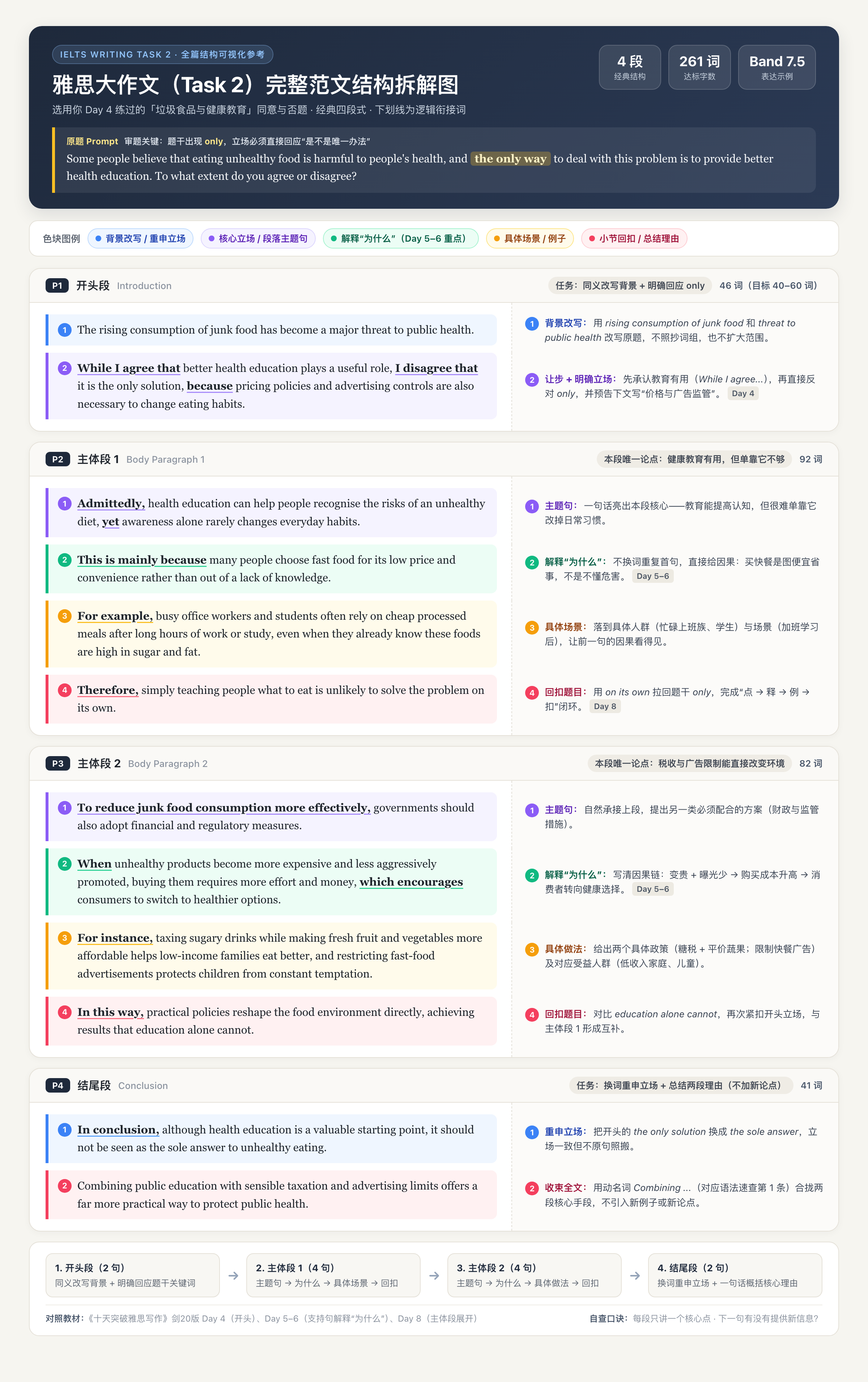
完整范文结构拆解图(同意与否题示例 · 261 词)
二、4 大考场题型 100% 覆盖(速查图 + 直接套用句型)
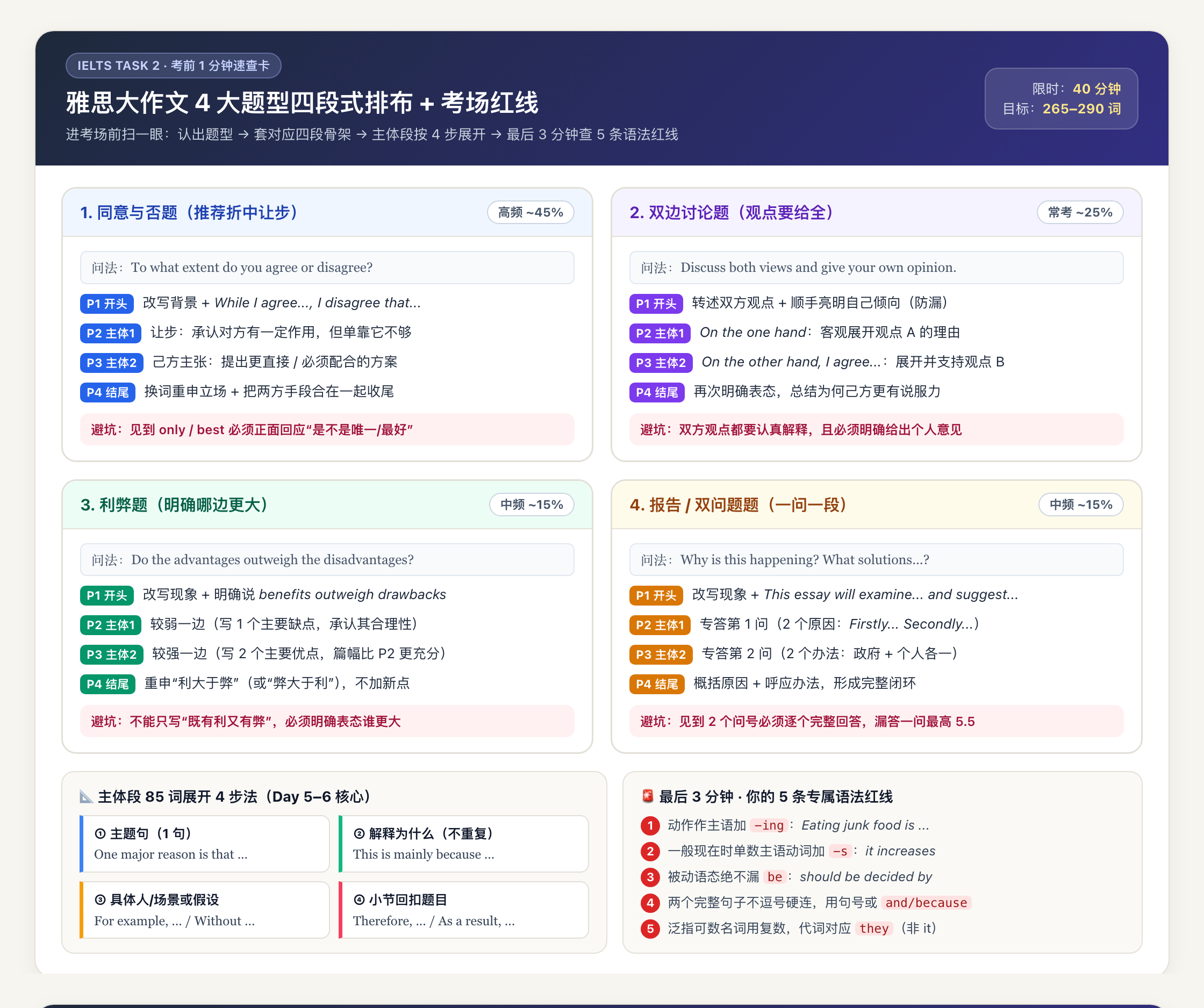
题型 1:同意与否题(To what extent do you agree or disagree? · 考场最高频 ~45%)
⚠️ 审题避坑:题干若出现
only / best / most effective(如你 Day 4 练的垃圾食品题),必须正面回应它是不是“唯一/最好”。最稳妥、最好凑满字数的写法是「折中让步」:先承认对方有一定道理,再说明为什么它不够、需要结合其他做法。
- 开头:
[背景改写]. While I agree that [对方做法] plays a useful role, I disagree that it is the only / best solution, because [己方核心理由] are also necessary. - Body 1(让步 + 指出局限):
Admittedly, [对方做法] can help ..., yet [它单独做不到什么]. This is mainly because ... - Body 2(己方更好/补充方案):
To tackle this issue more effectively, [己方方案] should also be adopted. When ..., ... - 结尾:
In conclusion, although [对方] is a valuable starting point, it should not be seen as the sole answer. Combining [A] with [B] is a far more practical way to ... - 完整范文:直接看上方「垃圾食品与健康教育」261 词拆解图。
题型 2:双边讨论题(Discuss both views and give your own opinion · ~25%)
⚠️ 审题避坑:《作业本》第 17 页允许开头只转述双方、个人意见留到结尾;考场更防漏的写法是在开头顺手亮明立场,结尾再重申一次,确保考官一眼看到
your own opinion!
- 开头:
People hold different views on whether [观点 A] or [观点 B]. While some argue that [A], I believe [B / 结合两者] is more beneficial in the long run. - Body 1(讨论另一方):
On the one hand, supporters of [A] believe that ... This is because ... - Body 2(讨论并支持己方):
On the other hand, I agree with those who argue that [B] ... - 结尾:
In conclusion, although [A] has certain merits, I am convinced that [B / 两者结合] ...
264 词 6.5–7.0 分大白话范文(双边讨论 · 你 Day 4 练过的「竞争 vs 合作」题)
原题:Some people think that a sense of competition in children should be encouraged. Others believe that children who are taught to cooperate rather than compete become more useful adults. Discuss both these views and give your own opinion.
P1 开头(44 词|转述双方 + 亮明立场)
People hold different views on how children should be raised. While some believe that encouraging competition prepares children for the future, others argue that teaching them to cooperate is more valuable. In my opinion, cooperation is more important, although healthy competition also has benefits.P2 主体段 1(88 词|先讲竞争的合理之处:点 → 释 → 例 → 扣)
On the one hand, a sense of competition can motivate children to work harder and improve their skills. This is mainly because competing with others gives students clear goals and pushes them out of their comfort zones. For example, when students prepare for a maths contest or a school sports event, they often practise more regularly and learn how to handle pressure. As a result, moderate competition can build confidence and help young people perform better in exams and future job interviews.P3 主体段 2(89 词|再讲合作的更大价值:点 → 释 → 例 → 扣)
On the other hand, teaching children to cooperate brings greater long-term benefits in adult life. Most modern workplaces require people from different backgrounds to solve complex problems together rather than work alone. For instance, in a team project at school, children learn how to listen to different ideas, share tasks fairly, and support teammates when difficulties arise. Without these teamwork skills, even very smart individuals may struggle to get along with colleagues and contribute effectively to a company or community.P4 结尾(43 词|重申立场 + 总结两方)
In conclusion, although healthy competition can encourage children to achieve personal goals, cooperation plays a much bigger role in helping them become useful members of society. Therefore, parents and schools should focus mainly on developing children's teamwork skills from an early age.
题型 3:利弊题(Do the advantages outweigh the disadvantages? · ~15%)
⚠️ 审题避坑:题目问“利是否大于弊”,必须明确表态哪一边更大,绝不能只写“既有利又有弊”。写的时候,站队的那一边(Body 2)写得更充分!
- 开头:
[现象改写]. While this trend brings certain drawbacks, I believe its benefits far outweigh the disadvantages. - Body 1(较弱一边 · 写 1 个主要缺点):
Admittedly, one major drawback of [主题] is that ... For example, ... - Body 2(较强一边 · 写 2 个主要优点):
However, the advantages are far more significant. First, ... Moreover, ... - 结尾:
In conclusion, despite some valid concerns over [缺点], the positive impacts of [主题] clearly outweigh the negative ones.
题型 4:报告 / 双问题题(原因+办法 / 两个问号 · ~15%)
⚠️ 审题避坑:见到两个问号(如 Why is this happening? What measures can be taken?),Body 1 专门答第 1 问,Body 2 专门答第 2 问,每段写 2 个清楚的小点,绝不漏答!
- 开头:
[现象背景改写]. This essay will examine the main reasons behind this trend and suggest several practical ways to address it. - Body 1(专答第 1 问:原因):
There are two main causes of this problem. Firstly, ... Secondly, ... - Body 2(专答第 2 问:办法):
To tackle this issue effectively, both governments and individuals should take action. On the one hand, the government can ... On the other hand, individuals should ... - 结尾:
In conclusion, [现象] is mainly driven by [原因 1 和 2]. Combining government policies with individual efforts offers the most realistic solution.
三、考场想不出理由?6 个万能“大白话理由抽屉”
考场 10 秒内从下面挑 2 个最贴题的,90% 的雅思大作文都能直接套:
| 万能角度 | 适用话题 | 考场直接可用的大白话短语 |
|---|---|---|
| 1. 钱与成本 | 教育 / 政府 / 消费 / 科技 | makes ... more affordable for low-income families(让低收入家庭负担得起)creates more job opportunities(创造更多就业机会) |
| 2. 时间与效率 | 科技 / 工作 / 交通 / 网购 | saves time for busy workers and students(为忙碌的上班族和学生省时间)allows people to focus on more important tasks(让人专注更重要的事) |
| 3. 身心健康 | 饮食 / 手机 / 运动 / 城市 | reduces stress and anxiety(减轻压力和焦虑)leads to health problems such as obesity and poor sleep(导致肥胖和睡眠变差) |
| 4. 人际与孤立 | 社交媒体 / 远程办公 / 教育 | weakens face-to-face communication(削弱面对面交流)helps young people develop teamwork skills(帮年轻人培养团队合作能力) |
| 5. 环境与未来 | 能源 / 交通 / 旅游 / 城市 | reduces air pollution and carbon emissions(减少空气污染和碳排放)protects natural habitats for wildlife(保护野生动物栖息地) |
| 6. 公平与公共服务 | 政府投资 / 医疗 / 贫富 / 教育 | widens the gap between the rich and the poor(拉大贫富差距)ensures equal access to quality education(保障平等获得优质教育) |
四、把干巴理由撑成 85 词主体段的“4 步防卡壳公式”
记住你在 Day 5–6 练的核心:第 2 句千万不要换词重复第 1 句,要回答“为什么”!
- ① 亮观点(主题句):
One major benefit of ... is that ... - ② 讲“为什么”(因果链):
This is mainly because .../When ..., people are more likely to ... - ③ 落到具体人或场景(举例 / 反面假设):
- 正面举例:
For example, busy office workers / university students / low-income families often ... - 反面假设(你语法速查第 9 条):
Without ..., we would lose / have less ...
- 正面举例:
- ④ 拉回题目(小节回扣):
Therefore, .../As a result, ...
五、不背生僻词!10 组稳妥 6.5–7.0 替换 + 你的 5 条专属红线
10 组零拼写风险替换(考场顺手换掉口语词)
| 尽量少写 | 稳妥替换(好拼又地道) | 尽量少写 | 稳妥替换(好拼又地道) |
|---|---|---|---|
a lot of |
a growing number of / many |
solve |
tackle / address |
kids |
children / young people |
important |
vital / essential |
good |
beneficial / effective |
big |
major / significant |
bad |
harmful / damaging |
think |
argue / believe |
get |
gain / develop |
nowadays |
in modern society / today |
考场最后 3 分钟 · 你的 5 条专属语法红线(来自 我的英语语法速查.md)
六、今晚 30 分钟极速急救实操
- 前 10 分钟:对照着看一遍上面的「Task 2 范文拆解图」和「竞争 vs 合作」双边讨论范文,感受每段 4 句话的节奏。
- 中 10 分钟:拿一张纸,不看笔记默写 4 种题型的开头第 2 句 + 主体段 4 步连接词(
Admittedly / This is mainly because / For example / Therefore)。 - 后 10 分钟:挑 1 道真题(例如“科技让人更孤独还是更亲近”),用 4 分钟列中文提纲 + 6 分钟只写开头和 Body 1,写完用上面 5 条红线逐条打勾!